
We have been hard at work building the next public build of Rankbreaker, and it’s finally time to start talking about it.
A few months back we attempted a large refactor of the game’s core systems. It didn’t work. We rolled it back and wrote about that whole mess in an earlier post, which you can read here. What we ended up doing instead was bigger than a refactor. We rebuilt the entire engine that Rankbreaker runs on. Not a high polish pass. Not a balance patch. A new game underneath the game you already know.
It’s taken a little over two months, and we’re closing in on a build we’re proud enough to show. If you’re in our Discord server [link here], you’ve probably already caught a few screenshots we’ve been dropping. New card abilities, new resolution mechanics, new movement rules, and honestly a new way to play a match from start to finish.
Why We Broke Our Own Game
When Rankbreaker first broke ground, the goal was simple. Take the parts of Marvel Snap we loved, bolt on a real economy, throw in some MMO-flavored systems, and build something that felt familiar but deeper. For a while, that worked. One of our Steam reviews put it best, and not entirely as a compliment: “Marvel Snap, but without the IP.” We nailed the Snap feel a little too well .
The problem was that familiarity became a ceiling. The gameplay looked and felt so close to what players already knew that our deeper systems never got a chance to breathe. You had to grind through your first handful of matches before the game even started showing you what made it different. Most players never got that far. Why would they, when the surface looked like something they’d already played?
So we sat down, read the reviews, talked to the players who stuck around long enough to care, and started tearing the board apart.
From Three Lanes to a Tower You Climb
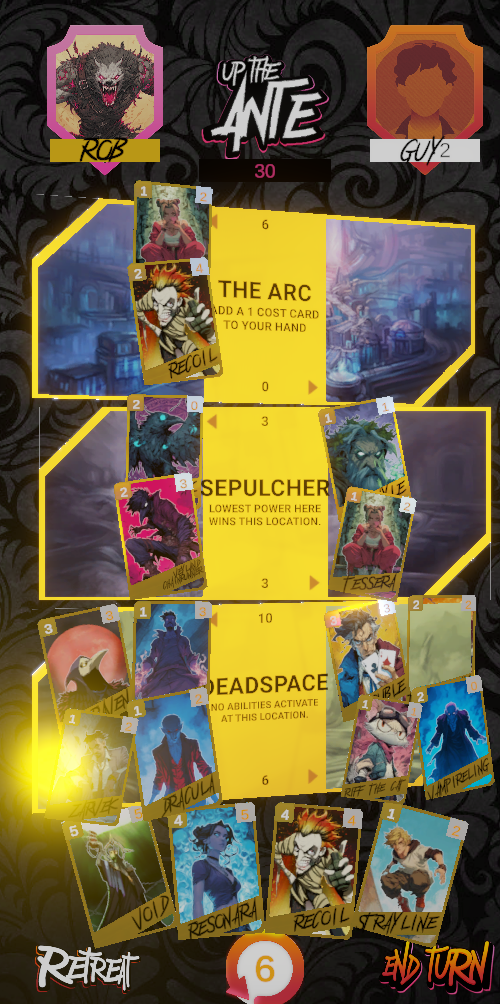
Rankbreaker no longer plays out on three horizontal lanes. That layout is gone. In its place, you climb a tower.
The three locations are still here and still familiar, but the orientation flips the whole match on its head. Instead of your opponent playing cards across from you on a flat field, they’re playing to your left, building their own column while you build yours. That single change reshapes almost everything downstream of it, from positioning to timing to how a comeback actually feels.
The win condition hasn’t changed. Take two of the three locations and you win. What’s changed is what it takes to get there. You’re no longer just fighting for raw power on a lane. You’re building a column, card by card, and that column has to hold together.
Here’s the part that makes it interesting. Cards can move, get bounced back to hand, or get destroyed outright. When that happens inside a column, it leaves a gap. That gap doesn’t just sit there. You get one round to fill it before gravity takes over, and everything above the gap shifts down until the column settles again. Miss that window, and your board rearranges itself whether you wanted it to or not.
It’s a small rule with a huge ripple effect. Every card you play is also a structural decision, not just a tempo one.
Introducing Card Properties
To make gravity actually mean something strategically, we built a new system called Card Properties. Right now there are three live, plus one we’re keeping under wraps for a little longer because it’s too good to spoil early.
Float cards can be played anywhere on the field, support or no support underneath them. The tradeoff is real though. A Float card can’t support anything else. If a card above it exists and gravity reconciles, that card falls right through the Float like it isn’t there.

Anchor cards are the opposite deal. You need support underneath to play one, but once it’s placed, it’s locked in. Gravity reconciliation won’t move an Anchor, even with cards stacked on top of it. It’s the one piece of your column you can always count on staying put.
Heavy cards are wrecking balls. If a gap opens up beneath a Heavy card, it doesn’t gently settle into place. It smashes through everything below it on the way down, destroying cards in its path until it either hits the floor of the arena or runs into something that can stop it. Only Anchors and face down cards can bring a falling Heavy card to a halt.

Stack those three properties against each other and you start to see the kind of board control this system opens up. Protect a key card behind an Anchor. Bait an opponent into stacking value on a column you’re planning to collapse with a Heavy. Slide a Float into a spot nobody else could reach. None of this existed in the old build. All of it exists now.
And there’s a fourth property waiting in the wings. We’re not ready to talk about it yet, but if you’ve been enjoying Float, Anchor, and Heavy, you’re going to want to keep an eye on our Discord for when we finally pull the curtain back.
Real Multiplayer, Real Stakes
The rebuild wasn’t just about the board. We also moved away from our old asynchronous backbone. Async features still exist in Rankbreaker and they’re not going anywhere, but the core of the game now runs on a two client, headless server setup.
If tech jargon isn’t your thing, here’s the plain version. That means real live multiplayer. Not the kind where you’re technically playing against another person’s saved moves from an hour ago. Actual live multiplayer, and cross-play on top of it, so it doesn’t matter what platform you’re on to sit across the tower from someone else.
That shift changes what a match in the Trophaeum actually feels like. You’re not being matched against a snapshot anymore. You’re matched against a live opponent, and the rank points you’re playing for started the match sitting in their account, not some abstract pool. Win, and you’re taking their rank points. Lose, and yours go the other way.
This has technically always been true of how Rankbreaker’s ranking system works under the hood. But now that you’re facing a real person on the other end of that column instead of a recorded state, it actually feels like something. Every match in the Trophaeum has a person behind it, and your rank points are genuinely on the line.
What’s Next
This rebuild has been the hardest stretch of development Rankbreaker has gone through, and it’s not finished yet. But the foundation underneath the game is finally the one we actually wanted to build on from day one. The next public build is close, and when it lands, it’s going to feel like a genuinely different game wearing a familiar name.
If you want to follow the build in real time, screenshots, dev notes, and the eventual reveal of that fourth Card Property, our Discord is where it’s all happening first.